Harbin Mosque, also known as Daowai Mosque or Binjiang Mosque, is located in the heart of Daowai District, Harbin. Originally founded in 1897 (the 23rd year of the Guangxu Emperor's reign) as the Harbin East Mosque, it began as five simple thatched cottages built with donations from the local Hui Muslim community. As the Muslim population grew during the construction of the Chinese Eastern Railway, the mosque underwent major reconstruction in 1904 and was expanded into its current Arab-style prayer hall in 1935, designed by the Russian architects the Klabliao siblings. In 1958, the East Mosque, West Mosque, and Women's Mosque merged into what is now known as Harbin Mosque. Later renovations in 1979, 1990, and 2003 further enhanced the complex.
Arab Architectural Splendor
Harbin Mosque is the largest Islamic mosque in Northeast China and the only Arab-style mosque among China's approximately 1,500 mosques. The main prayer hall stands 13 meters high with a floor area of 426 square meters and can accommodate 500 to 600 worshippers. The hall features a brick-and-wood structure with a roughly square floor plan—the main hall measures 27.4 meters long and 16 meters wide, while the side halls measure 27.4 meters long and 18 meters wide.
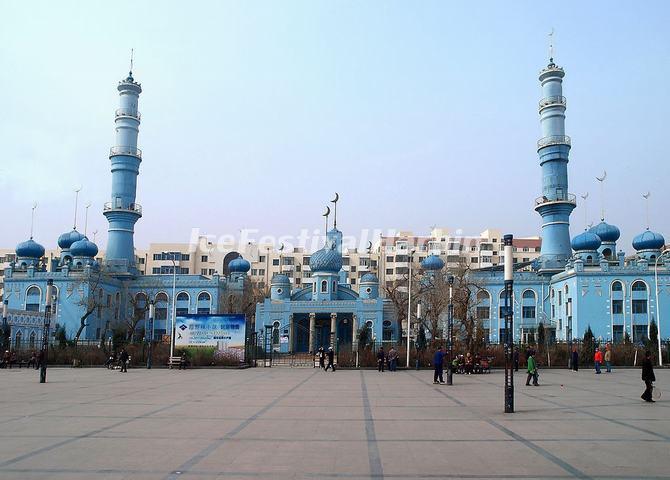
The mosque's most striking features are its five domes (one large and four small) crowning the wooden roof, each topped with a crescent moon, the universal symbol of Islam. The rear hall contains a 21.75-meter minaret, known as the Wangyue Tower (Moon-Watching Tower), traditionally used to observe the new moon at the start of Ramadan and Eid. Two 50-meter minarets flank the main structure, each rising five stories with spiral staircases inside, designed after the minarets of the Grand Mosque of Mecca and the Prophet's Mosque in Medina.
The main facade features a symmetrical layout with a four-columned Corinthian portico at the entrance, and architectural details incorporating geometric patterns and floral motifs throughout. The building's pale blue tones and crescent-topped domes create a serene, majestic presence. In front of the mosque lies a 1.8-hectare Arab Square, used for major religious gatherings and as a public leisure space, with the courtyard capable of holding over 3,000 people.

Religious Activities and Global Connections
As the principal mosque in Heilongjiang Province's capital, Harbin Mosque serves as a vital center for Islamic religious life. It receives more than 300 important international Muslim visitors annually from countries including Panama, Sudan, Malaysia, Turkey, and a dozen Middle Eastern nations, along with over 100,000 Muslim worshippers from across China each year. The mosque holds regular daily prayers, Friday congregational prayers, and special observances during Ramadan and Eid, making it a must-visit destination for Muslim travelers exploring Harbin.
Practical Information
-Address: No. 270, Shisidao Street, Daowai District, Harbin
-Admission: Free
-Opening Hours: Open all day
-Recommended Visit Duration: 20–30 minutes
-Getting There: Accessible by city bus and taxi from Harbin Railway Station and Harbin Taiping International Airport
-Etiquette: Visitors should dress conservatively, remove shoes before entering the prayer hall, and cover their heads if required during prayer times
Whether you are drawn by its distinctive Arab architecture, its century of history, or its role as Northeast China's largest Islamic center, Harbin Mosque offers a meaningful and enriching experience in the heart of Daowai District.

 Zhangjiajie Avatar Tours