The New Synagogue of Harbin, originally constructed in 1918 and completed in 1921, stands as the largest and best-preserved synagogue in Northeast China and the Far East. Encompassing 2,400 square meters with a height of 23.59 meters, the synagogue could accommodate up to 800 worshippers. Designed by renowned Jewish architect Joseph Yuryevich Levkin, the building features a distinctive brick-and-stone structure with a grand semicircular dome topped by a six-pointed Star of David, horseshoe-shaped doors and windows, and a three-door main entrance with four columns supporting pointed arches. Its façade is adorned with alternating red and white brickwork, a hallmark of its unique architectural style.

Harbin once boasted the largest Jewish population in the Far East. During the late 19th and early 20th centuries, the city served as the largest political, economic, and cultural center for Jewish people in the region. Completed in 1921, the synagogue functioned not only as an important place of religious observance and community education but also housed a public library on its second floor, which was used by Zionist organizations. The synagogue ceased religious activities in 1956 following the mass departure of Jewish residents from the city. It was later repurposed as a club for the local Public Security Bureau and suffered significant damage, including the destruction of its original dome. In 2004, the Harbin Municipal Government launched a comprehensive restoration project following the principle of "restoring the old as it was," reconstructing the dome and pointed-arch windows and restoring the total floor area to 2,400 square meters.
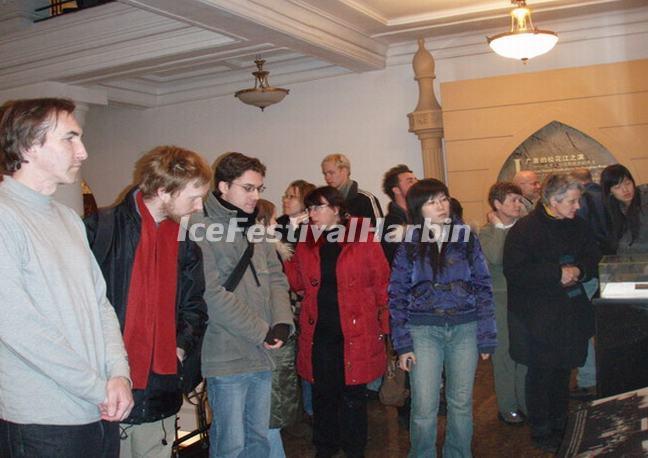
After restoration, the synagogue was transformed into the Harbin Jewish History and Culture Museum. The museum's second and third floors host the permanent exhibition "Harbin Jewish History and Culture," displaying over 500 historical photographs, archival documents, and artifacts that systematically present the life and legacy of Jewish people in Harbin from the late 19th to the mid-20th century. The ground floor features the "Gazing – Architectural Art Exhibition," showcasing photographs and paintings of buildings constructed by Jews in Harbin during the first half of the 20th century. The museum also serves as an important site for descendants of former Harbin Jews from around the world to trace their roots.
Most of Harbin's Jews migrated from Russia during the construction of the Far East Railway. The construction of the railway linking Vladivostok and Harbin attracted approximately 60,000 Jews to Northeast China from Russia at the end of the 19th century. Local Jews made tremendous contributions to the development and prosperity of Harbin over the past century. Priceless Jewish architecture can be seen throughout the city, including synagogues, banks, schools, and shops built in the early 20th century. Near the New Synagogue stands a unique Jewish middle school. Another example of Jewish-style architecture, the Harbin Huangshan Jewish Cemetery, located in the city's suburbs, is the largest and best-preserved Jewish cemetery in the Far East, serving as the resting place for more than 500 Harbin Jews. In June 2004, Ehud Olmert, then Israel's deputy prime minister, paid respects to his grandfather buried in the cemetery. This historical architecture is listed as protected landmarks by the city. Each year, many descendants of Harbin Jews from all over the world return to look for their roots.
In 2013, the synagogue was designated as a Major Historical and Cultural Site Protected at the National Level as part of the "Harbin Jewish Activity Sites" complex. As of 2026, the synagogue is a branch of the Harbin Museum and remains an important cultural landmark for understanding the history of Harbin's Jewish community and China's diverse cultural heritage.
Visitor Information
-Address: 162 Jingwei Street, Daoli District, Harbin
-Opening Hours: 8:30 AM – 5:00 PM daily (last entry at 4:45 PM); some sources indicate Tuesday to Sunday 9:00 AM – 4:00 PM, closed on Mondays
-Admission: 25 RMB for adults; free for children under 1.2 meters, seniors over 70 with valid ID, and disabled visitors
-By Bus: Routes 162, 21, 105, 112, 74
-Phone: 0451-87630882

 Zhangjiajie Avatar Tours