
Harbin Jile Temple, also known as the Temple of Bliss, is located at No. 9 Dongdazhi Street in Nangang District, Harbin. As the largest Buddhist architectural complex in Heilongjiang Province and one of the Four Great Buddhist Temples of Northeast China — alongside Prajna Temple in Changchun, Ci'en Temple in Shenyang, and Lengyan Temple in Yingkou — it stands as a living center of Chinese Buddhism in the region.
History and Founding
Jile Temple was initiated in 1921 by General Zhu Qinglan, Commander-in-Chief of the Chinese Eastern Railway Guard, and Chen Feiqing, Director of the Harbin Railway Bureau Inspection Office, with the support of local Buddhist devotees. The temple was founded by the eminent monk Master Tanxu, the 44th Patriarch of the Tiantai School of Buddhism. Construction began in the spring of 1923 and was completed in August 1924. The temple was named "Jile" (Ultimate Bliss) because Master Tanxu's first sermon in Harbin in 1922 was on the Amitabha Sutra, and the founders were adherents of the Pure Land school. Master Tanxu served as the temple's first abbot and led its expansion over six years, establishing it as a major Buddhist center in Northeast China. In 1983, the temple was designated by the State Council as a National Key Buddhist Temple in the Han Chinese Region, and in 1981 it was listed as a Cultural Relic Protection Unit of Heilongjiang Province. It remains the seat of the Heilongjiang Provincial Buddhist Association, with Master Jingbo serving as abbot and president.
Architecture and Layout
The temple occupies 53,500 square meters with a building area of 3,000 square meters, organized into four sections: the main courtyard, the east side courtyard, the west side courtyard, and the pagoda courtyard. The principal buildings along the central axis include the Mountain Gate, the Hall of Heavenly Kings, the Mahavira Hall, the Hall of the Three Saints, and the Sutra Repository, flanked by the Bell Tower and Drum Tower. The architecture follows the traditional Chinese temple style, with buildings constructed of blue bricks and glazed colored tiles. The Mahavira Hall enshrines a 2.7-meter-high seated statue of Shakyamuni Buddha, with standing statues of Ananda and Mahakasyapa on either side. The Sutra Repository houses precious cultural relics, including block-printed Buddhist scriptures from the Song Dynasty. The temple also serves as the home of Harbin Buddhist College, which trains monks from across the region.
The Seven-Story Pagoda
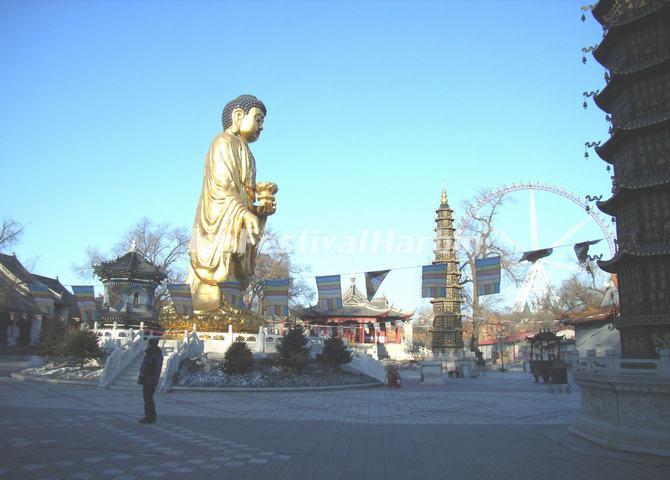
The temple's most distinctive landmark is the Seven-Story Pagoda, also known as the Buddhist Treasure Pagoda, located in the east courtyard. Built between 1939 and 1941 through donations organized by Master Jinglang, a disciple of Master Tanxu, the pagoda is an octagonal seven-tiered brick-and-stone structure rising approximately 30 meters. Its exterior features arched niches containing relief sculptures of 31 arhats on the east, south, and west faces, while the north face has windows on the upper three levels. The pagoda is directly connected to the Ksitigarbha Hall at its base, an unusual architectural feature. The pagoda is listed as a Cultural Relic Protection Unit of Heilongjiang Province.
Cultural Significance and Festivals
Jile Temple remains one of the most active and popular Buddhist temples in Harbin. It is particularly known for its temple fairs, held on the first and fifteenth days of each lunar month, as well as on the eighth, eighteenth, and twenty-eighth days of the fourth lunar month. During these festivals, the temple grounds fill with worshippers and visitors, creating a vibrant atmosphere of devotion and cultural celebration. The temple also hosts major annual Buddhist ceremonies, including the Ullambana Festival and commemorative services for past masters. Each hall carries its own significance for worshippers: the Mahavira Hall is associated with wealth and career, the Guanyin Hall with making wishes, the Hall of Heavenly Kings with peace and good fortune, and the Medicine Hall with health and longevity.

 Zhangjiajie Avatar Tours